
📘 Mega In‑Depth
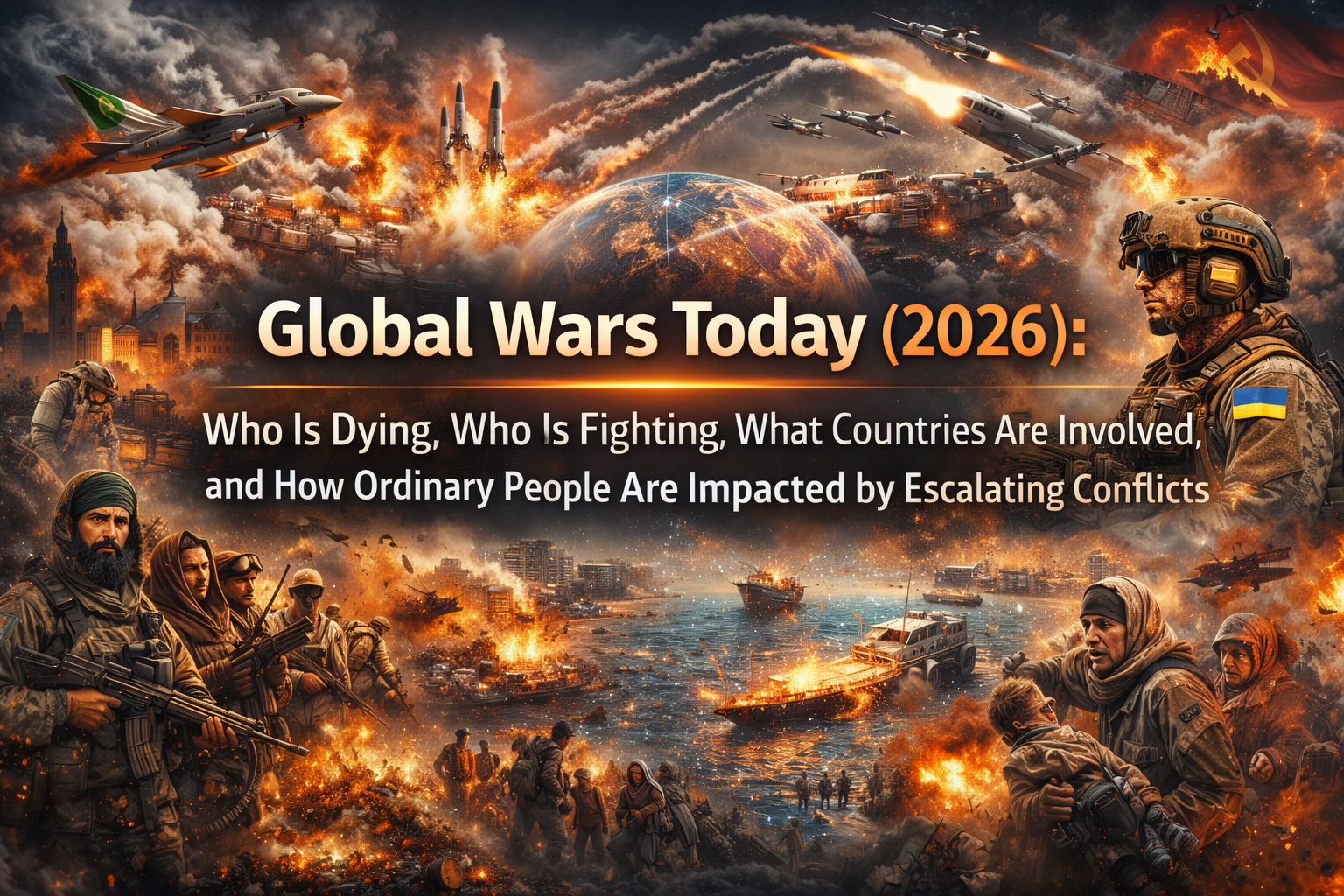
War and conflict have shaped human history, but the nature, scale, and global interconnectedness of conflicts in 2026 reveal a world where localized wars spill far beyond borders — affecting economies, societies, and millions of lives. This blog explores who is fighting whom, who is dying, why these conflicts matter, and how ordinary people are paying the price.
📌 1. The Middle East War (United States + Israel vs. Iran and Allies)
🚀 Background of the Conflict
In February 2026, the United States and Israel launched a coordinated military assault on Iran — one of the most significant escalations in the region in decades. The joint operation targeted Iranian military bases, missile infrastructure, nuclear facilities, and high‑ranking commanders in what U.S. and Israeli officials say was a strategic effort to prevent Iran from obtaining nuclear weapons and to degrade its ability to project power across the Middle East.
🎯 Key Events & Escalation
The operation, described by some analysts as Operation Epic Fury or Roaring Lion, involved large‑scale airstrikes and precision missile attacks on major Iranian cities including Tehran, Isfahan, Qom and more.
Iran responded with ballistic missiles, drones and proxy attacks targeting not just Israeli territory but also U.S. military bases and allied Gulf states like Bahrain, Kuwait, Saudi Arabia, Qatar, Iraq and the United Arab Emirates (UAE).
Iran’s closure of the Strait of Hormuz — a key maritime route through which about 20% of the world’s oil exports pass — disrupted global energy markets and raised the stakes for global economic stability.
💥 Casualties and Impact
The human toll has already been severe:
Iranian sources report hundreds of deaths including civilians from strikes on populated urban areas and schools.
At least six U.S. military personnel have been confirmed killed during operations, with more wounded.
Lebanese group Hezbollah and Lebanese civilians have also been drawn into the conflict, with rockets and air raids across the Lebanon–Israel border.
Other Gulf states have reported foreign civilian deaths (Pakistanis, Nepalese, Bangladeshi) from Iranian missile and drone attacks.
⚔️ Proxy Involvement
Iran‑backed militias and groups such as Hezbollah in Lebanon have opened another front, firing rockets into northern Israel and prompting heavy air responses.
The conflict has engulfed multiple countries across the Middle East and appears far from being contained.
🧠 Geopolitical Stakes
The U.S. and Israel aim to prevent nuclear proliferation and blunt Iran’s influence, while Iran frames its response as defense of its sovereignty. However, such a large war draws in alliances, fuels proxy battles, and risks a much larger regional conflagration.
🌍 2. Pakistan–Afghanistan Open War
Simultaneously, in South Asia Pakistan and Afghanistan have entered an open, declared state of war after months of escalating tensions and border skirmishes.
⚔️ What Happened
Pakistan launched airstrikes deep into Afghanistan — including Kabul, Kandahar and other major urban centers — after accusing the Afghan Taliban government of permitting militant groups to attack Pakistan’s border posts.
In response, Afghan forces — including Taliban‑aligned units — engaged Pakistani military targets in border regions.
💣 Casualties & Human Toll
Estimates vary, but hundreds of military personnel and civilians have died on both sides following Pakistani claims of insurgent and Taliban leader fatalities, and Afghan reports of Pakistani military losses.
📍 Why This Matters
This war highlights deep historic mistrust, border disputes, and accusations of cross‑border militancy, destabilizing an already fragile region and risking broader Pakistani, Afghan and regional impact.
🇷🇺 3. The Russia‑Ukraine Conflict Continues
Though not always dominating headlines amid the Middle East escalation, fighting between Russia and Ukraine continues in 2026 — with heavy artillery exchanges, missile barrages, and frequent clashes across eastern Ukraine.
📉 Daily Dangers
Russia regularly launches attack drones, bombs, and missiles targeting Ukrainian infrastructure and cities.
Ukraine responds with its own counter‑strikes, including targeting Russian logistics and supply lines.
🧠 Why It Still Matters
This conflict, now lasting more than three years, continuously disrupts civilian life, displaces populations, and adds long‑term humanitarian and economic consequences across Europe.
🌏 4. Other Conflicts & Humanitarian Crises Worldwide
Beyond these headline wars, 2026 remains a year filled with localized but severe conflicts:
🔥 African and Asia Conflicts
Sudan and South Sudan face renewed civil violence and instability.
Myanmar, Sahel nations and other regions experience ongoing civil strife.
📌 Israel–Hamas & Gaza Conflict (Historical Continuation)
Though its intensity varies over time, the longstanding conflict between Israel and Palestinian groups like Hamas remains unresolved, with periodic escalation and ceasefire cycles. (Note: historical statistics reveal tens of thousands killed and displaced over years of fighting.)
🧍♂️ 5. Who Is Dying and Why It Matters
Across all conflicts, the highest toll by far falls on civilians — ordinary people caught between military forces, living in cities that become battlegrounds, schools, hospitals, homes, and marketplaces.
Children, women, elderly individuals, migrants, and foreign workers are among those suffering most — through deaths, injuries, displacement, loss of livelihoods, psychological trauma, and shattered communities.
Modern wars increasingly affect urban areas and infrastructure — not just military bases — making the human cost devastating.
📉 6. Economic & Global Ripple Effects
🌐 Disrupted Energy Markets
The closure or threat to the Strait of Hormuz affects global oil prices and supply chains.
📦 Trade & Shipping Risks
Shipping delays, halted routes, and maritime dangers affect global trade and manufacturing.
💱 Humanitarian Crisis Costs
Refugee flows strain neighboring nations, while reconstruction and healthcare needs overwhelm fragile systems.
🧠 7. What These Wars Teach Us
These conflicts show a grim reality:
Wars are rarely contained — local disputes transform into international crises.
Civilians always pay the highest price.
Conflicts affect global economics, politics, food, energy security, and migration.
Diplomacy struggles to keep pace with escalations.
📌 Conclusion: A World in Conflict
In 2026, war is not limited to one place — it spans the Middle East, Asia, Europe, and Africa. Countries with powerful militaries may think strategically, but the real cost is counted in everyday lives — lost families, broken homes, displaced children, and societies pushed deeper into poverty and trauma.
Understanding these conflicts helps us see not just who is fighting whom, but why peace is so urgently needed.
War and conflict have shaped human history, but the nature, scale, and global interconnectedness of conflicts in 2026 reveal a world where localized wars spill far beyond borders — affecting economies, societies, and millions of lives. This blog explores who is fighting whom, who is dying, why these conflicts matter, and how ordinary people are paying the price.
📌 1. The Middle East War (United States + Israel vs. Iran and Allies)
🚀 Background of the Conflict
In February 2026, the United States and Israel launched a coordinated military assault on Iran — one of the most significant escalations in the region in decades. The joint operation targeted Iranian military bases, missile infrastructure, nuclear facilities, and high‑ranking commanders in what U.S. and Israeli officials say was a strategic effort to prevent Iran from obtaining nuclear weapons and to degrade its ability to project power across the Middle East.
🎯 Key Events & Escalation
The operation, described by some analysts as Operation Epic Fury or Roaring Lion, involved large‑scale airstrikes and precision missile attacks on major Iranian cities including Tehran, Isfahan, Qom and more.
Iran responded with ballistic missiles, drones and proxy attacks targeting not just Israeli territory but also U.S. military bases and allied Gulf states like Bahrain, Kuwait, Saudi Arabia, Qatar, Iraq and the United Arab Emirates (UAE).
Iran’s closure of the Strait of Hormuz — a key maritime route through which about 20% of the world’s oil exports pass — disrupted global energy markets and raised the stakes for global economic stability.
💥 Casualties and Impact
The human toll has already been severe:
Iranian sources report hundreds of deaths including civilians from strikes on populated urban areas and schools.
At least six U.S. military personnel have been confirmed killed during operations, with more wounded.
Lebanese group Hezbollah and Lebanese civilians have also been drawn into the conflict, with rockets and air raids across the Lebanon–Israel border.
Other Gulf states have reported foreign civilian deaths (Pakistanis, Nepalese, Bangladeshi) from Iranian missile and drone attacks.
⚔️ Proxy Involvement
Iran‑backed militias and groups such as Hezbollah in Lebanon have opened another front, firing rockets into northern Israel and prompting heavy air responses.
The conflict has engulfed multiple countries across the Middle East and appears far from being contained.
🧠 Geopolitical Stakes
The U.S. and Israel aim to prevent nuclear proliferation and blunt Iran’s influence, while Iran frames its response as defense of its sovereignty. However, such a large war draws in alliances, fuels proxy battles, and risks a much larger regional conflagration.
🌍 2. Pakistan–Afghanistan Open War
Simultaneously, in South Asia Pakistan and Afghanistan have entered an open, declared state of war after months of escalating tensions and border skirmishes.
⚔️ What Happened
Pakistan launched airstrikes deep into Afghanistan — including Kabul, Kandahar and other major urban centers — after accusing the Afghan Taliban government of permitting militant groups to attack Pakistan’s border posts.
In response, Afghan forces — including Taliban‑aligned units — engaged Pakistani military targets in border regions.
💣 Casualties & Human Toll
Estimates vary, but hundreds of military personnel and civilians have died on both sides following Pakistani claims of insurgent and Taliban leader fatalities, and Afghan reports of Pakistani military losses.
📍 Why This Matters
This war highlights deep historic mistrust, border disputes, and accusations of cross‑border militancy, destabilizing an already fragile region and risking broader Pakistani, Afghan and regional impact.
🇷🇺 3. The Russia‑Ukraine Conflict Continues
Though not always dominating headlines amid the Middle East escalation, fighting between Russia and Ukraine continues in 2026 — with heavy artillery exchanges, missile barrages, and frequent clashes across eastern Ukraine.
📉 Daily Dangers
Russia regularly launches attack drones, bombs, and missiles targeting Ukrainian infrastructure and cities.
Ukraine responds with its own counter‑strikes, including targeting Russian logistics and supply lines.
🧠 Why It Still Matters
This conflict, now lasting more than three years, continuously disrupts civilian life, displaces populations, and adds long‑term humanitarian and economic consequences across Europe.
🌏 4. Other Conflicts & Humanitarian Crises Worldwide
Beyond these headline wars, 2026 remains a year filled with localized but severe conflicts:
🔥 African and Asia Conflicts
Sudan and South Sudan face renewed civil violence and instability.
Myanmar, Sahel nations and other regions experience ongoing civil strife.
📌 Israel–Hamas & Gaza Conflict (Historical Continuation)
Though its intensity varies over time, the longstanding conflict between Israel and Palestinian groups like Hamas remains unresolved, with periodic escalation and ceasefire cycles. (Note: historical statistics reveal tens of thousands killed and displaced over years of fighting.)
🧍♂️ 5. Who Is Dying and Why It Matters
Across all conflicts, the highest toll by far falls on civilians — ordinary people caught between military forces, living in cities that become battlegrounds, schools, hospitals, homes, and marketplaces.
Children, women, elderly individuals, migrants, and foreign workers are among those suffering most — through deaths, injuries, displacement, loss of livelihoods, psychological trauma, and shattered communities.
Modern wars increasingly affect urban areas and infrastructure — not just military bases — making the human cost devastating.
📉 6. Economic & Global Ripple Effects
🌐 Disrupted Energy Markets
The closure or threat to the Strait of Hormuz affects global oil prices and supply chains.
📦 Trade & Shipping Risks
Shipping delays, halted routes, and maritime dangers affect global trade and manufacturing.
💱 Humanitarian Crisis Costs
Refugee flows strain neighboring nations, while reconstruction and healthcare needs overwhelm fragile systems.
🧠 7. What These Wars Teach Us
These conflicts show a grim reality:
Wars are rarely contained — local disputes transform into international crises.
Civilians always pay the highest price.
Conflicts affect global economics, politics, food, energy security, and migration.
Diplomacy struggles to keep pace with escalations.
📌 Conclusion: A World in Conflict
In 2026, war is not limited to one place — it spans the Middle East, Asia, Europe, and Africa. Countries with powerful militaries may think strategically, but the real cost is counted in everyday lives — lost families, broken homes, displaced children, and societies pushed deeper into poverty and trauma.
Understanding these conflicts helps us see not just who is fighting whom, but why peace is so urgently needed.
Discussion
0 comments💭
No comments yet. Be the first to share your thoughts!
💝 Subscribe to join the discussion and share your thoughts.